

Preparing for your first immigration court hearing Houston first immigration court hearing Houston means understanding what happens inside the courtroom, what documents to bring, and what the immigration judge will ask you. Many people receive a Notice to Appear and panic, but knowing the process reduces fear and helps you make better decisions. The Houston immigration court for your first immigration court hearing Houston follows specific procedures that we can prepare you for step by step.
What the Notice to Appear Actually Means
A Notice to Appear is the document that starts removal proceedings against you. It contains the formal allegations the government is making about your immigration status and the legal charges against you. Receiving this document does not mean you are automatically deported. It means the government is asking an immigration judge to determine whether you should be removed.
I know how terrifying it feels to receive government paperwork that threatens your life in this country. My mother and I went through our own immigration journey, and I built this practice to help Houston families facing these exact moments. At Zavala Immigration Law Firm, we explain every document in plain language so you never feel lost.
Reading and Understanding the Charges
The Notice to Appear lists specific allegations about your entry, your current status, and the immigration law sections the government claims you violated. Understanding these charges is the first step in building your defense. The Executive Office for Immigration Review oversees all immigration courts, including the Houston court.
What Happens if You Ignore the Notice
Ignoring a Notice to Appear is the worst thing you can do. If you fail to attend your hearing, the immigration judge can order you removed in absentia. This means you get deported without the chance to present your case. An in absentia order is extremely difficult to reopen and creates a 10-year bar to most forms of relief.
Practical rule: Never ignore a Notice to Appear. Showing up is the single most important thing you can do for your case.
Where Houston Immigration Court Hearings Take Place
The Houston Immigration Court is located at 4141 Southwest Freeway, Suite 600, Houston, TX 77027. This is where most first immigration court hearing Houston proceedings occur. The building is accessible by car and public transit, but you should arrive early to allow time for security screening.
What to Expect Walking In
When you arrive at the immigration court building, you will go through a security checkpoint similar to an airport. Remove metal items from your pockets and place bags on the scanner. After security, take the elevator to the sixth floor where the immigration court suites are located. Check in with the court clerk at the window and wait for your name to be called.
Parking and Transportation to Houston Immigration Court
Paid parking is available near the building but fills up quickly on hearing days. Arrive at least 45 minutes early to find parking and clear security. Metro bus routes serve the Southwest Freeway area. If you have an attorney, they can often provide specific parking recommendations.
- Address: 4141 Southwest Freeway, Suite 600, Houston, TX 77027
- Arrive 45 minutes early for security screening
- Bring photo identification for court check-in
- Dress professionally, as outlined in the EOIR practice guide, as a sign of respect for the court
- Do not bring food or drinks into the courtroom
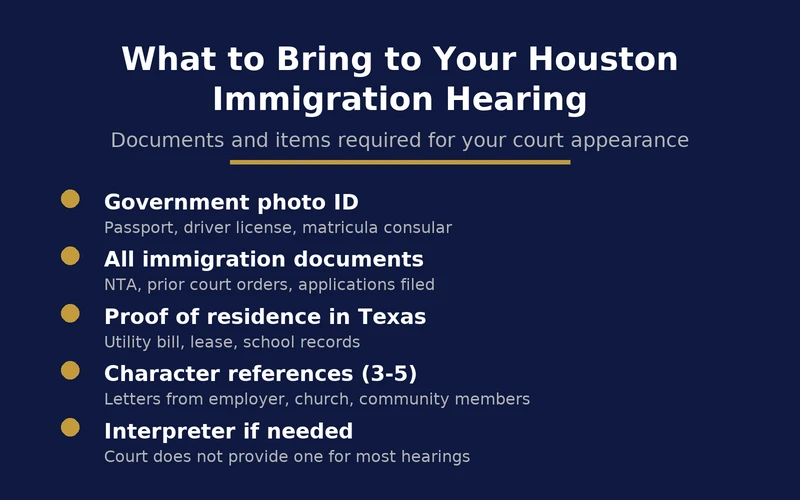
Practical rule: The Houston immigration court does not provide interpreters for all languages. Bring a qualified interpreter if you need one and are unsure whether the court will provide one.
The Master Calendar Hearing: Your First Appearance
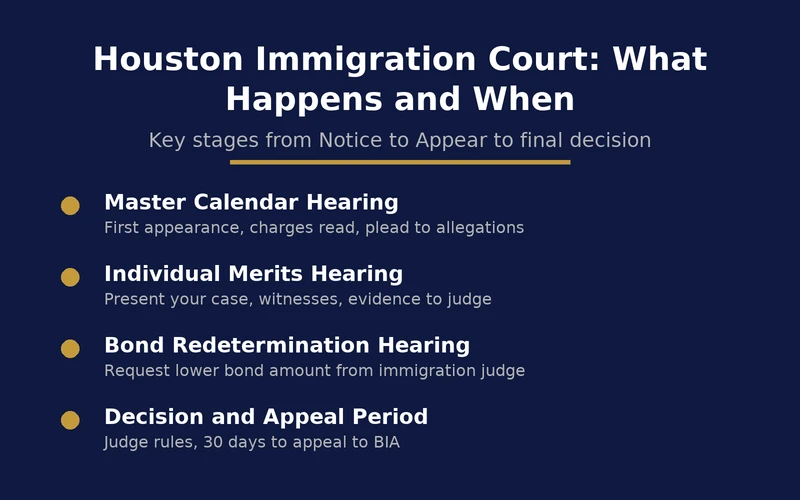
The master calendar hearing is your first immigration court hearing Houston. This hearing is brief, usually lasting 5 to 15 minutes. The immigration judge will explain the charges against you, advise you of your rights, and ask how you plead to the allegations.
What the Judge Will Ask You
The judge will ask you to confirm your name, address, and date of birth. They will read the allegations from your Notice to Appear and ask whether you admit or deny each charge. The judge will also ask whether you have an attorney or need time to find one. If you need time, the judge will schedule your next hearing.
How to Plead to the Allegations
You can admit or deny each allegation. You can also request a continuation to find an attorney before pleading. If you admit the allegations, the judge will ask what relief you are seeking. If you deny them, the government must prove the charges at an individual hearing.
We strongly recommend having an attorney before your master calendar hearing. What you say at this first immigration court hearing Houston shapes your entire case. Our deportation defense team attends master calendar hearings with our clients to protect their rights from the first moment.
Requesting Time to Find an Attorney
If you do not have an attorney at your first hearing, you can request a continuance. The judge will typically grant one continuance of 2 to 4 weeks to give you time to find legal representation. Use this time wisely. Contact our Houston immigration attorneys immediately to schedule a consultation.
Designating a Country of Removal
The judge will ask you to designate a country of removal. This is the country to which you would be deported if removal is ordered. You can designate your country of citizenship or refuse to designate, which means the government chooses. Designating does not mean you agree to be removed, but it is a required procedural step.
Practical rule: Request a continuance to find an attorney before answering substantive questions. What you say at the master calendar hearing can be used against you later.
Preparing Your Documents and Evidence
Preparation is the most important factor in how your first immigration court hearing Houston first immigration court hearing Houston goes. Gathering the right documents before your hearing date shows the judge you are taking the process seriously.

What to Bring to Court
Bring original copies of all immigration documents you have ever received. This includes your Notice to Appear, any prior court orders, work permits, visa applications, and correspondence from USCIS. Also bring government-issued photo identification and proof of your Houston residence.
Character References and Supporting Documents
Letters from employers, church leaders, community members, and family members can support your case. These letters should describe your good moral character, family ties, and contributions to the Houston community. We help our clients identify the most effective character references for their specific situation.
- Government photo ID (passport, driver license, matricula consular)
- All immigration documents including the Notice to Appear
- Proof of residence in Texas (utility bill, lease, school records)
- Character reference letters from employer, church, community members
- Medical records if claiming medical hardship
- Police clearance certificates if you have any criminal history
What Not to Bring to Court
Do not bring food, drinks, or sharp objects into the courthouse. Turn off your phone before entering the courtroom. Do not bring children unless the court specifically requires their presence. Do not bring original documents you cannot afford to lose without making copies first.
Types of Relief Available in Immigration Court
Even if the government proves you are removable, you may qualify for relief that allows you to stay in the United States. Knowing your options before your hearing helps you make strategic decisions.
Cancellation of Removal for Non-Permanent Residents
If you have lived in the United States for at least 10 years, have good moral character, and can show that your removal would cause exceptional and extremely unusual hardship to a U.S. citizen or permanent resident spouse, parent, or child, you may qualify for cancellation of removal. This is one of the most powerful forms of relief but also one of the hardest to prove.
Adjustment of Status Through a Family Member
If you are married to a U.S. citizen or have an approved family petition, you may be able to adjustment of status through the court. This depends on how you entered the country and whether you need a waiver for unlawful presence. Our family immigration team evaluates whether this option applies to your case.
Asylum and Withholding of Removal
If you fear persecution in your home country based on race, religion, nationality, political opinion, or membership in a particular social group, you may qualify for asylum. The deadline for filing asylum is generally one year from your arrival in the United States, with limited exceptions. The USCIS asylum page provides official information on eligibility.
Voluntary Departure as a Backup Option
If no other relief is available, requesting voluntary departure allows you to leave the United States at your own expense within a set timeframe. This avoids the penalties of a formal removal order, which can include a 10-year bar to reentry.
Practical rule: Never assume you have no options. An experienced immigration attorney can identify relief you may not know exists.
Immigration Bonds and Release From Detention
If you are detained before your hearing, you may be eligible for an immigration bond. The bond allows you to be released from detention while your case proceeds. The minimum bond amount is typically $1,500, but the judge can set it higher based on your flight risk and criminal history.
How to Request a Bond Hearing
Your attorney can request a bond redetermination hearing before the immigration judge. At this hearing, the judge considers your family ties, community connections, employment history, and criminal record to set or lower the bond amount. Having strong character references and a stable residence in Houston helps reduce the bond.
What Happens if Bond Is Denied
If the judge denies bond or sets it too high, you can appeal to the Board of Immigration Appeals. In some cases, detainees with certain criminal convictions are subject to mandatory detention and cannot get a bond hearing at all. Our attorneys at our East Freeway office handle bond hearings regularly.
What Happens After the First Hearing
Your first immigration court hearing Houston is the first of several appearances and the beginning of a legal process, not the end of your case. The judge will schedule subsequent hearings, either another master calendar or an individual merits hearing.
The Individual Merits Hearing
If you deny the allegations and request relief, your case proceeds to an individual hearing. At this hearing, you present testimony, witnesses, and evidence to support your case. The government attorney can cross-examine you and present evidence against you. The judge then issues a decision, either granting relief or ordering removal.
Appealing the Judge’s Decision
If the judge orders removal, you have 30 days to appeal to the Board of Immigration Appeals. During the appeal, your removal is typically stayed. If the BIA denies your appeal, you may appeal to the federal circuit court. Each level of appeal requires experienced legal representation.
Working With Your Attorney Throughout the Process
Your attorney should attend every hearing with you, prepare you for testimony, file all motions, and keep you informed of every development. We at our Greenspoint office maintain regular communication with our clients throughout their court proceedings.
Practical rule: The individual hearing is your one chance to present your full case. Every document, witness, and piece of evidence must be prepared in advance.
| Question | Answer |
|---|---|
| Do I need a lawyer for my first immigration court hearing Houston? | You are not required to have a lawyer, but having one dramatically improves your chances. The government will have an attorney, and you should too. |
| What if I cannot afford an attorney? | The court does not provide free attorneys for immigration cases. You can request a continuance to find an attorney or contact nonprofit organizations for assistance. |
| How long does the first hearing last? | Master calendar hearings typically last 5 to 15 minutes. The judge will schedule your next hearing at the end. |
| Can I bring my family to court? | Family members can attend, but the courtroom is small. Do not bring children unless their presence is required. |
| What should I wear to immigration court? | Dress professionally, as outlined in the EOIR practice guide, as a sign of respect. Business casual is appropriate. Avoid shorts, flip-flops, and t-shirts with slogans. |
| Will the judge deport me at the first hearing? | No. The first hearing is procedural. The judge will explain charges, ask for your plea, and schedule the next hearing. |
| What happens if I miss my court date? | The judge will order you removed in absentia. This creates a 10-year bar and is very difficult to reopen. Always attend your hearings. |
What Relief Looks Like in Practice for Houston Families
Every first immigration court hearing Houston case follows a unique path depending on the individual’s history, family ties, and available evidence. Understanding how different types of relief work in real cases helps you prepare for your own hearing.
When Cancellation of Removal Applies
Cancellation of removal for non-permanent residents requires showing 10 years of continuous physical presence, good moral character, and exceptional and extremely unusual hardship to a U.S. citizen or lawful permanent resident spouse, parent, or child. The hardship standard is very high. Normal hardship from family separation does not meet the threshold. You must show that your qualifying relative would suffer hardship significantly beyond what would normally be expected from deportation.
For Houston families, we build these cases with school records showing children’s academic progress, medical records showing ongoing treatment needs, and financial records showing the family’s dependence on the applicant’s income. The Immigration and Nationality Act Section 240A on law.cornell.edu defines the legal requirements for cancellation of removal.
When Asylum May Be the Strongest Option
If you fear returning to your home country because of persecution based on race, religion, nationality, political opinion, or membership in a particular social group, asylum may be your strongest form of relief. Asylum has no 10-year presence requirement and can lead to permanent residency after one year. However, the one-year filing deadline requires careful attention. If more than one year has passed since your arrival, you must qualify for an exception.
The ACLU immigrants’ rights resources provide educational information about asylum and other forms of humanitarian relief available in immigration proceedings.
Maintaining Your Status While Your Case Is Pending
After your first immigration court hearing Houston, your case may take months or years to resolve. You may be eligible for a work permit while your removal case is pending, depending on your case type. If you have applied for asylum and the case has been pending for more than 180 days, you may qualify for an EAD.
If you move while your case is pending, you must notify the immigration court within 5 days using Form EOIR-33. Failing to update your address can result in missing hearing notices, which leads to in absentia removal orders. Do not travel outside the United States without consulting your attorney first.
| Type of Relief | Key Requirements | Typical Timeline |
|---|---|---|
| Cancellation of Removal | 10 years presence, good moral character, exceptional hardship | 1 to 2 years for individual hearing |
| Asylum | Well-founded fear of persecution, filed within 1 year of arrival | 6 months to 3 years depending on backlog |
| Adjustment of Status | Approved family petition, admissible or waiver available | 6 to 18 months |
| Voluntary Departure | Good moral character, ability to depart at own expense | 60 to 120 days to leave |
| Withholding of Removal | More likely than not to face persecution | Same timeline as asylum hearing |
Practical rule: Filing for relief is not a guarantee. The quality of your evidence and testimony determines whether the judge grants your application. Prepare every document and witness months in advance of your first immigration court hearing Houston individual hearing.
Frequently Asked Questions About Houston Immigration Court Hearings
Facing Your Houston Immigration Hearing With Confidence
Your first immigration court hearing Houston is the start of a legal process, not the end of your life in this country. With proper preparation, strong legal representation, and a clear understanding of your rights, you can face the judge with confidence. Call our team for your first immigration court hearing Houston at (713) 974-8284 or visit our contact page to schedule a consultation. Zavala Immigration Law Firm stands with Houston families in immigration court every day.
About Eliud Zavala, Eliud Zavala is the founder of Zavala Immigration Law Firm in Houston, Texas. Having immigrated to the United States with his mother from Monterrey, Mexico, Eliud understands the emotional and legal struggles immigrant families experience. He built his practice around serving the Houston immigrant community, guiding individuals and families through family-based immigration, marriage green cards, provisional waivers, deportation defense, and citizenship.