

What the Supreme Court Actually Decided
The 6-3 Vote and What It Means
Chief Justice John Roberts wrote the majority opinion, joined by Justices Sotomayor, Kagan, Barrett, and Ketanji Brown Jackson. Their ruling is grounded in the 14th Amendment itself: “All persons born or naturalized in the United States and subject to the jurisdiction thereof, are citizens of the United States.” The Court held this language means exactly what it says and has meant the same thing for more than 160 years.
In Roberts’ words: “Citizenship, then and now, was the right to have rights , to freely participate in our political community. The Framers of the Fourteenth Amendment extended that promise to ‘every free-born person in this land.’ We keep that promise today.”
Justice Kavanaugh’s Separate Concurrence
Justice Brett Kavanaugh agreed the executive order must be struck down, but wrote separately. He said he would not reach the constitutional question , instead, he found the order violates federal statutory law, specifically the Immigration and Nationality Act (INA), which Congress passed in 1952 to codify birthright citizenship. This matters because it signals a possible path for future legislative action: if Congress were to amend the INA, the constitutional question could return. That has not happened, and any such change would face its own legal challenges. But it is something immigration attorneys are watching closely.
Who Dissented
Justices Thomas, Alito, and Gorsuch dissented. They argued the 14th Amendment was intended only to guarantee citizenship to freed slaves, not to apply broadly to children of undocumented or temporarily present parents. Their view did not prevail today, but the 3-vote dissent means this debate is not fully closed within the Court.
Who Was Actually Affected by Trump’s Executive Order
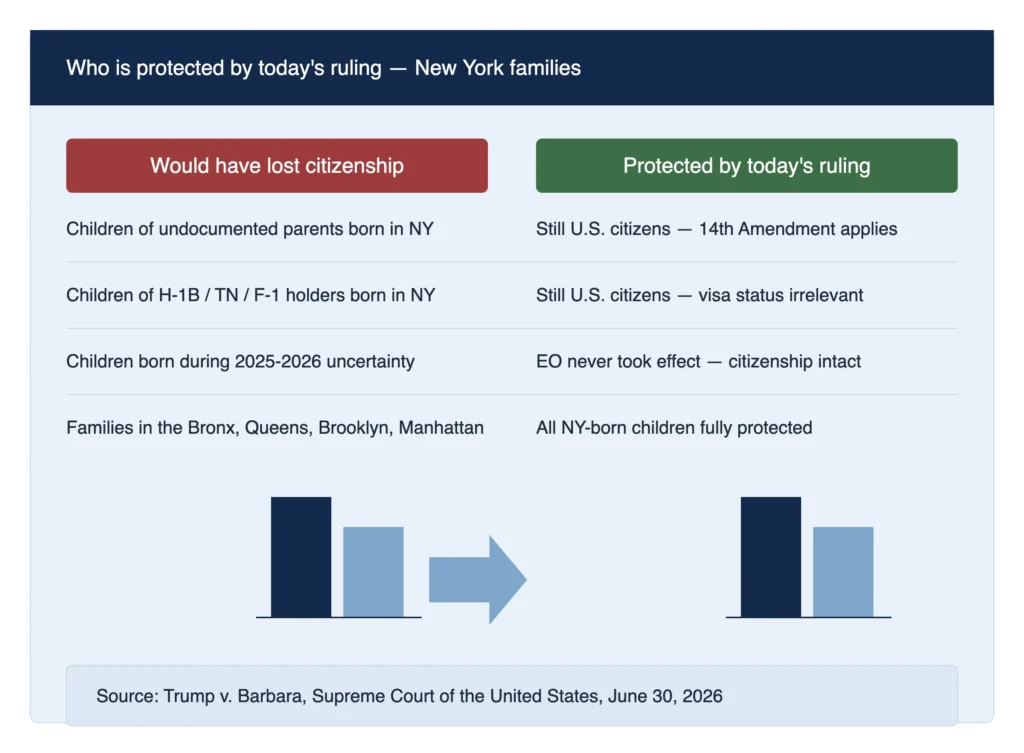
Children of Undocumented Parents
Trump’s order would have denied citizenship to children born in the U.S. to parents who entered the country without authorization. Under the order, these children would have been born stateless , without citizenship in the U.S. or, in many cases, in their parents’ home countries. That outcome is now blocked. If your child was born here, they are a U.S. citizen, regardless of your immigration status. Our family-based immigration attorneys in Houston can help you understand how that connects to your own case.
Children of Parents on Temporary Visas
The order also targeted children born to parents on temporary work or visitor visas; H-1B, H-4, TN, F-1, and similar statuses. Under the executive order, these children would not have been granted citizenship. The Supreme Court’s ruling means that children born in the United States to parents on temporary visas remain U.S. citizens. This was an issue affecting many of the professional and working families we serve at Zavala Immigration Law Firm.
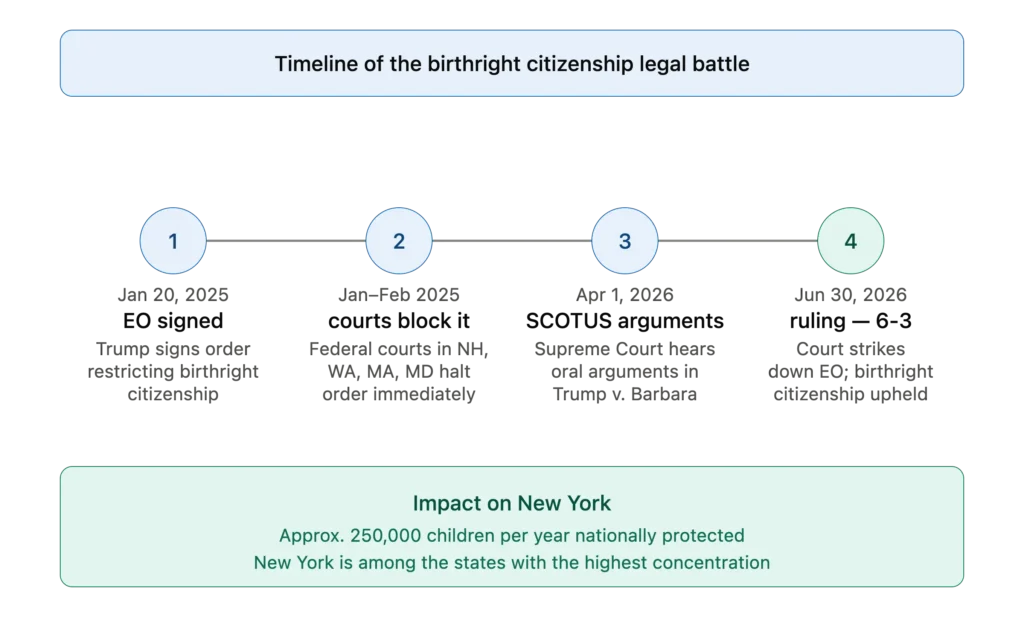
The 250,000 Annual Births at Stake
According to the Migration Policy Institute and Penn State’s Population Research Institute, approximately 250,000 babies are born in the United States each year who would have been denied citizenship under the executive order. Today’s ruling protects every one of those children going forward.
The History Behind Today’s Decision
The Wong Kim Ark Case | 1898
This is not a new question. The Supreme Court addressed birthright citizenship more than a century ago in United States v. Wong Kim Ark (1898). Wong Kim Ark was born in San Francisco to Chinese immigrant parents. When he returned from a visit to China in 1895, he was denied re-entry on the grounds that he was not a citizen. The Supreme Court ruled 6-2 that he was, in fact, a U.S. citizen by birth. That ruling has governed American law for 128 years. Today’s decision reaffirms it.
Congress Codified It Twice
Congress reinforced the constitutional understanding of birthright citizenship in federal statute, first through the Nationality Act of 1940, and again through the Immigration and Nationality Act of 1952. This is the statutory law Justice Kavanaugh cited in his concurrence. The legal foundation for birthright citizenship is not just constitutional, it is also written into the law Congress passed.
Even in Periods of Hostility Toward Immigrants
Roberts’ opinion noted something important: even during periods of extreme hostility toward immigration in U.S. history, including during World War II when Japanese Americans were held in internment camps, the children of those individuals born on U.S. soil were automatically granted citizenship. The principle has held across every political moment this country has faced.
What This Means If You Are Pregnant or Planning a Family
No Disruption to Existing Citizen Children
If your child was already born in the United States and has a U.S. birth certificate, today’s ruling changes nothing for them. Their citizenship was never in question under existing law, and it remains fully protected.
Children Born From This Day Forward
The executive order, had it taken effect, would have applied only prospectively, meaning to children born after its effective date. Since the order never took effect and has now been permanently struck down, no child born in the United States going forward will be affected by it. Birthright citizenship continues exactly as it has for more than a century.
If You Had Questions During the Uncertainty
Over the past 18 months, many families came to our office with real fear about what this executive order might mean for their newborns. That uncertainty was exhausting and unfair. If you still have questions about your child’s citizenship documentation, how to obtain a U.S. passport for your child, or how your family’s immigration case interacts with your child’s citizenship, we are here. A consultation with our team can give you clarity specific to your situation.
What Happens Next?
The Kavanaugh Signal: Could Congress Act?
Justice Kavanaugh’s decision to rule only on statutory grounds and not reach the constitutional question, was deliberate. It leaves open the theoretical possibility that a future Congress could attempt to amend the Immigration and Nationality Act to restrict birthright citizenship. Such an effort would face enormous legal and political hurdles. It would almost certainly be challenged as unconstitutional under the 14th Amendment, and any such challenge would return to the courts. We will monitor this closely.
The Three Dissenting Justices
Thomas, Alito, and Gorsuch represent a persistent minority view that the 14th Amendment was never intended to apply broadly to children of non-citizen parents. Their presence means future challenges through different legal vehicles or through new legislation, remain a possibility. The fight over birthright citizenship did not end today. It simply did not succeed today.
What This Means for Future Policy
Conservative lawmakers who have long sought to end birthright citizenship through legislation will likely treat today’s ruling as motivation to pursue a statutory approach. That process, if it begins, will take years and will face the same 14th Amendment barrier the executive order faced. For now, the law is clear and settled.
Practical rule: If your child was born in the United States, they are a U.S. citizen. That did not change today, today’s ruling confirmed it.
How This Affects TN Visa Holders and Work Visa Families in Texas
The TN Visa Concern Many Did Not Know They Had
Many of the Mexican and Canadian professionals we serve in Houston on our TN visas had children born in the United States during the past year and a half of legal uncertainty. Some were told by employers or HR departments that their children’s citizenship might be at risk. It was not. And today’s ruling eliminates any remaining ambiguity. Your child born in the United States is a U.S. citizen, even if you are in this country on a temporary work authorization.
H-1B, H-4, and F-1 Families
The same applies to families on H-1B, H-4, F-1, and other temporary nonimmigrant visas. The executive order treated these families the same as undocumented immigrants for purposes of birthright citizenship. The Supreme Court rejected that framing entirely.
Your Questions Answered
| Question | Answer |
|---|---|
| My child was born in the U.S. while I was undocumented. Are they a citizen? | Yes. The Supreme Court confirmed this today. Your child’s birthright citizenship is fully protected under the 14th Amendment. |
| I’m on a TN visa. Is my U.S.-born child a citizen? | Yes. Children born in the U.S. to parents on temporary visas are U.S. citizens. Today’s ruling affirms this. |
| Did the executive order ever take effect? | No. It was blocked by every federal court that reviewed it and never took legal effect. Today’s ruling permanently strikes it down. |
| Could Congress still change the law? | Justice Kavanaugh’s concurrence leaves that door theoretically open, but any such change would almost certainly be challenged as unconstitutional. The 14th Amendment would still apply. |
| What should I do if I’m unsure about my child’s citizenship documentation? | Contact an immigration attorney. We can review your specific situation and help you obtain the right documentation for your child. |
| Does this ruling affect DACA or deportation cases? | Not directly , this ruling is specifically about birthright citizenship. But it reinforces the constitutional rights of U.S.-born children of immigrant parents, which can be relevant in certain removal defense cases. |
A Note From Our Firm
I have been an immigration attorney in Houston for over a decade. I am an immigrant myself. And I know what the past 18 months of uncertainty about birthright citizenship felt like for families who had done nothing wrong except build their lives here. The fear was real. The confusion was real. And today, the highest court in the country told those families clearly and by a strong majority, that the Constitution protected their children all along.
That is not a political statement. It is what the law says. It is what it has said for 160 years. And now it is confirmed again.
If you have questions about your family at Zavala Immigration Law Firm Houston‘s situation, your child’s documentation, your own immigration status, or how today’s ruling interacts with any pending case, reach out to us. We are here for the Houston immigrant community, as we always have been.
Practical rule: A Supreme Court ruling this clear and this decisive, with this long a historical foundation, does not get easily reversed. Your family can move forward with confidence today.
Your Child’s Future Starts Here. Zavala Immigration Is Ready to Help
Today’s decision protects your family. But navigating the full picture of your immigration case, your status, your child’s documentation, your path forward, requires legal guidance specific to your situation. Zavala Immigration has served Houston’s immigrant families for over 10 years. Call us at (713) 974-8284 or visit our contact page to schedule a consultation. We handle family immigration, TN visas, deportation defense, DACA renewals, and more, in English and Spanish.
About Eliud Zavala
Eliud Zavala is the founder of Zavala Immigration Law Firm in Houston, Texas. He immigrated with his mother and built his practice around the Houston immigrant community he grew up in. He handles family-based immigration, marriage green cards, provisional waivers, deportation defense, military parole in place, DACA renewals, and naturalization throughout Texas. He serves clients in English and Spanish at both the Greenspoint Park Drive and East Freeway Houston locations.